Les Paul 1915 - 2009
A most miraculous man is gone.
Site menu:
From my blog...
Write a Better Novel
July 4 , 2008
American fiction writer, Eudora Welty, saw clearly that to write a good story the writer had to be in control of not 1 but 2 sets of logic:
Outer logic–the chain of events and their consequences.
Inner logic, a private, character-based structure of forces that she called “the logic of the heart.”
[Five years ago, this dream assignment–for Attache, then US Airways' inflight magazine–
made it possible for me to hang out for an entire afternoon with one of my all-time culture
heros, Les Paul. Today, when I heard he had died, I was dumbfounded, even though the
man was 94. The 89-year-old Les Paul I got to know seemed like an unlikely prospect for
death, ever. I'm sorry to see him go, but mostly sorry for the rest of us, not for him. Les Paul
had the kind of life most of us only dream of. He lived it right up to the end and when he went,
it was a quick precipitous end. R.I.P. Les. We won't see his like again soon. –BH]
 Attache, 2004
Legend of Note: Les Paul
The amazing Les Paul is through with his groundbreaking sonic inventions. Now, at age 89, he’s doing the thing he loves best.
by Bill Henderson
In a recent Coors Lite commercial, a condescending young guitar show-off lets a senior citizen try a few licks on his Les Paul Standard. The old dude fires off a blues run so hot that everyone’s mouth drops open. “What’s your name, man?” says the young dandy. The old dude shrugs and glances at the stock. “It’s on your guitar.”
Out on Broadway, on a balmy afternoon, teenage boys cruising Times Square on spring break pull up momentarily in front of New York’s premier jazz club, Iridium.
“Wow, it’s Les Paul,” says one, reading the billboard. “Wow. He’s famous, isn’t he?” “Yeah, he’s like—Les Paul!”
Inside the club, the famous Les Paul is one happy guy. Blessed with a sunny nature, genuinely appreciative of a good joke and a good meal, Les Paul is happy because so many battles are behind him and he is still in the game, leading an active group of young jazz virtuosos. And happy because at the moment he’s doing what he loves best: tinkering.
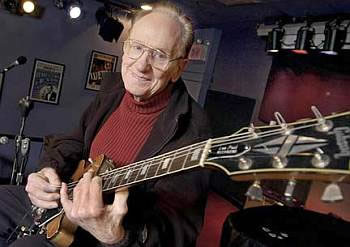
There is an obvious do-not-disturb aura around him as he sets and resets the controls on his amp and plays with the 1940s radio knobs on his old, funky-looking, hot-rod guitar (which, incidentally, is not a "Les Paul"). Stepping off the stage, he wanders purposefully through the club with his guitar, sitting here, sitting there, sampling the sound from various spots. In momentary repose, his face looks as though it might belong on Mount Rushmore. He has big ears, big hands, and massive arthritic fingers that move around the guitar neck as if they were a single mass.
“I don’t play chords anymore with these fingers,” he says later, between bites of a meal brought backstage by a waiter. He displays one hand without a hint of self-pity. “Just leads and fills.”
Arthritis is a problem; Les Paul fixes problems. In this case, he fixed it by adapting his technique to play what he’s still able to play—problem solved. After nearly a century on earth, Les Paul is what he has always been, a practical guy, a doer, and some even say--though you’ll never hear him use the word--a genius.
Lester Polsfuss, a.k.a. Red Hot Red, Rhubarb Red, or the Wiz of Waukesha (Wisconsin), has been around a long time. In his 89 years, he appears to have done everything, known everybody, been everywhere—with perfect historical timing. Born in 1915, he matured into a national radio star, playing guitar with Fred Waring in New York in the late ’30s: later with the Andrews Sisters; and finally, in Hollywood, with Bing Crosby, the reigning music megastar of the mid-‘40s.
Soon he was riding the crest of celebrity as a musical star in his own right. Most likely no one alive during the 50’s failed to hear at least one of the multiple Les Paul & Mary Ford singles that topped the charts several years running.
With characteristic “right-time, right-place” luck, he found himself perfectly placed to catch the wave of early TV. He and the photogenic Mary were soon syndicated nationally in a series of 15-minute “newlyweds at home” vignettes--the two of them washing dishes, play quarreling, making up—and performing a couple of their hits.
But Les Paul the virtuoso guitarist and star performer is only one of several narratives. Even more remarkable to me is the story of Les Paul the innovator and inventor. It’s that story—Les Paul as “visionary geek”—that never ceases to amaze me because it places him, Zelig-like, at the center of nearly every significant moment in the history of American recording and electric-guitar technology.
Any music-loving high schooler can tell you the names of the two mightiest of rock guitars—the Fender Stratocaster, and the Gibson Les Paul. When a famous name graces an instrument, chances are it represents only an endorsement. Not so in this case: not only did Les Paul design his namesake guitar, he made what might be the first electric in 1928, while still a teenager in Wisconsin. It was as “Rhubarb Red” that he improvised this innovation, the first (he claims) acoustic-electric ever. Why? He had a problem: the patrons of the sandwich shop where he played complained they couldn’t hear them. His solution was to jam the stylus from the family phonograph into the bridge of his guitar.
Years later, in 1941, he would approach the Gibson company with the archetypal solid-body electric, famously dubbed “The Log.” (It's now on display in the Country Music Hall of Fame Museum in Nashville.) But the Gibson execs thought exclusively in terms of finely crafted acoustic instruments and couldn't really grasp the key fact that Les had long known: that electric guitars produce the clearest tones, and sustain them the longest, when they have no acoustic properties at all. The Log was a four-by-four mini railroad tie with strings. Perfect–yet the the Gibson exec remained unswerving in their determination that an inert block of wood, regardless of its electronics, would never bear the Gibson name.
Only in 1952, after Leo Fender beat everyone to market with his own solid-body, the Broadcaster (renamed the Telecaster), did Gibson scramble to clear the way for what would finally be the most prestigious and recognized electric guitar in history, the Les Paul. As if that was not enough, Les Paul is also credited with conceiving the idea of multi-track recording. Having procured for Bing Crosby one of the first German tape recorders, he built his own garage studio in Hollywood, experiiment endlessly, and badgered the Ampex company into constructing the first eight-track studio recorder for his own use. His obsession with synchronous multitrack recording went back a ways—according to Les, as far back as an early fascination with his mother’s player piano (“the world’s first midi controller,” he jokes, knowing only other music geeks will get the joke). As early as 1934, he was mixing successive combinations of tracks directly to a master disk. Anyone familiar with the famous Les Paul–Mary Ford sound—guitar upon guitar upon guitar—will understand the significance of his experiments with what he called “disk multiples,” a technique that later came to be known as “sound-on-sound.”
Overdubbing on the first eight-track recorder was a quantum leap in the same direction, allowing more control and less loss of quality. Paul knew at the time what the industry was slow to grasp—that multi-track was more than just a way to get “that Les Paul sound.” It was a master tool that would soon revolutionize the way all music is created in the studio.
Given his style, if the recording studio was his canvas, Les needed the fullest possible palette of colors. On his recordings, he often played all the instrumental parts himself, hardly an uncommon practice today, but unheard of in 1950. To make his sound as unique and identifiable as possible, he developed many of the basic special effects we now take for granted.
Why all the gimmicks? He tells the following revealing tale: By 1946, radio had made him the most popular guitarist in the country. One morning the telephone rang. It was his mother. “Lester, I just heard a guitar player that sounds exactly like you. He almost fooled me. You need to do something about that.” “Well, Mother, I can’t arrest him.” “You’re a clever boy, Lester. You’ll think of something.”
Les can laugh about it now, but at the time it struck him as anything but funny. The message was: Son, you’re not unique. Or in Les’s own words, “How can you be a success if your own mother can’t even pick you out of the lineup?”
So it was goodbye to Chicago, where he had been a featured player on the top-rated Andrews Sisters’ radio show. Les took a train straight home to Hollywood and the little garage studio he had built with Bing Crosby’s encouragement. There he sequestered himself, determined not to emerge until he had built a new sound from the ground up, one that his mother and everybody else in the world would recognize as completely, unmistakably, his own.
What he came up with was shimmery, thick, reverberant—the sound of six or eight simultaneous Lesters, one layered on top of another. Then he sweetened the mix by adding the vocals of Mary Ford, similarly layered, and the result was one commercial hit after another: “Mockingbird Hill,” “Vaya Con Dios,” “The World Is Waiting for the Sunrise,” “Brazil.”
Now, a half-century later, music fans sometimes need to be reminded that the Les Paul of guitar and recording history is, as he puts it, “a man, not an instrument.” He’ll talk about the past, but he doesn’t live there. In a time when “classic” pop idols are recycled as living museum displays, Les Paul is all about today. Almost 90, he’s making some of the most interesting live music of his career—and he’s a hit: “Les Paul Mondays” has been a hot ticket at Iridium for nearly ten years. Unlike his old pal Bing Crosby, his friendly rival Leo Fender, his engineer buddies at Ampex, or his long-gone cohorts of ’50s pop, Les Paul is still happening. He hasn’t let history claim him yet—he’s too busy making good music.